You
Check-ins, conversation and assessments
A simple view for everyone first, then a closer look at how Mente Mirror keeps the AI inside defined safety, consent and human-review boundaries.
Your own check-ins remain central. Technology can add context, surface possible patterns and connect you with the next useful step.
Check-ins, conversation and assessments
Permitted behavioural and body-signal context
Consent, quality, access and workflow controls
Bring eligible context together without turning it into diagnosis
Reflection and approved wellness options
Professional judgement when appropriate
Designed for wellness support. AI and wearable signals provide context and are not presented as medical diagnosis, autonomous clinical judgement or emergency monitoring.
Important permissions and consequential decisions are designed to be owned by deterministic services and human workflows outside the conversational model.
Authentication, eligibility and consent gates decide what the service may access or do. The AI can explain status; it cannot override it.
Crisis, safeguarding and medical-urgency rules can pre-empt ordinary conversation and route to the approved pathway.
A separate memory policy controls what approved context can be retrieved or persisted; private notes are not ordinary AI memory.
The AI may guide only tools that pass the independent registry, consent, risk, contraindication and review rules.
The AI may draft or describe confirmed workflow status, but it should not invent a handoff, approve a report or make a formal diagnosis.
Why this matters: user messages, memory, sensor readings and reports are treated as information to work with—not as instructions that can silently change the product's safety or privacy rules.
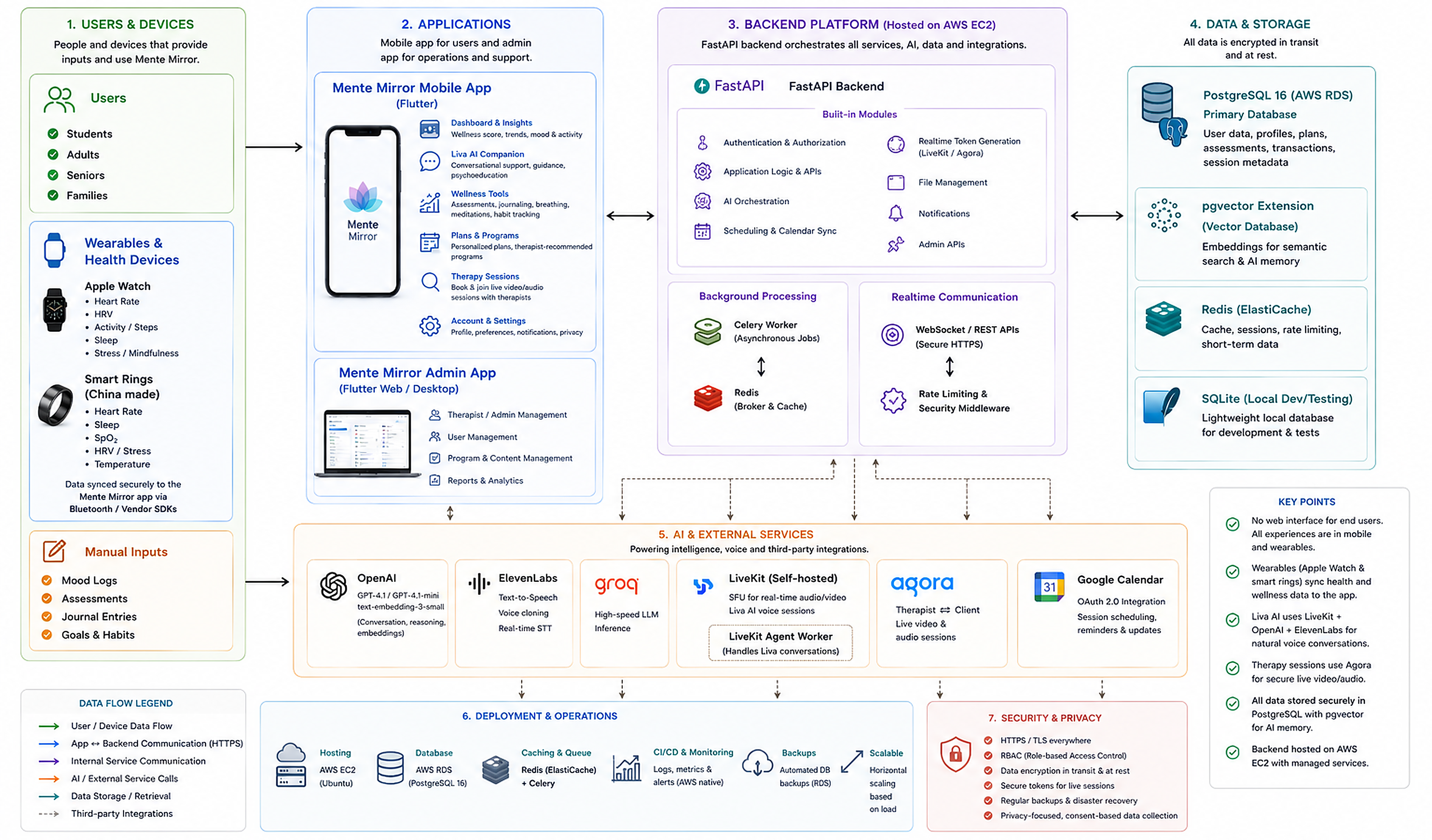
Open the high-resolution view to inspect the platform layers, integrations and data flow in more detail.